By Luis Villasenor, BS in Nutrition, Co-Founder of Ketogains & DrinkLMNT
Let’s clear something up right away.
Tadalafil (aka Cialis) did not wake up one day and decide its sole life purpose was erectile dysfunction. That’s just the job it became famous for. Like being typecast as “the hot villain” in a Netflix series when you’re actually a classically trained Shakespearean actor.
Tadalafil is, at its core, a vascular drug. A nitric-oxide–pathway modulator. A systemic endothelial-support compound. And yes—sometimes it helps erections. But erections are just visible blood flow. The real story is what’s happening everywhere else.
And that story applies to both men and women.
Let’s unpack it—science first, jokes second, nonsense never.
How Tadalafil Actually Works (Plain English Edition)
Tadalafil is a PDE5 inhibitor.
PDE5 (phosphodiesterase type 5) is an enzyme that breaks down cGMP, a signaling molecule that allows blood vessels to relax and stay relaxed. When PDE5 is active, blood vessels constrict sooner. When you inhibit it, vasodilation lasts longer.
What tadalafil does not do:
It does not “create” nitric oxide
It does not directly stimulate arousal
It does not act like caffeine or a stimulant
What it does do:
Prolongs the effect of nitric oxide
Improves endothelial function (the lining of your blood vessels)
Enhances blood flow systemically, not just below the belt
Think of it as keeping the highway open longer, not adding more cars.
Why This Matters Beyond Sex (For Both Sexes)
Blood flow is not a party trick. It’s infrastructure.
When vascular function improves, downstream systems benefit:
Which is why tadalafil keeps showing up in research contexts that have nothing to do with sex.
Cardiovascular Health & Longevity: The Quiet Heavyweight
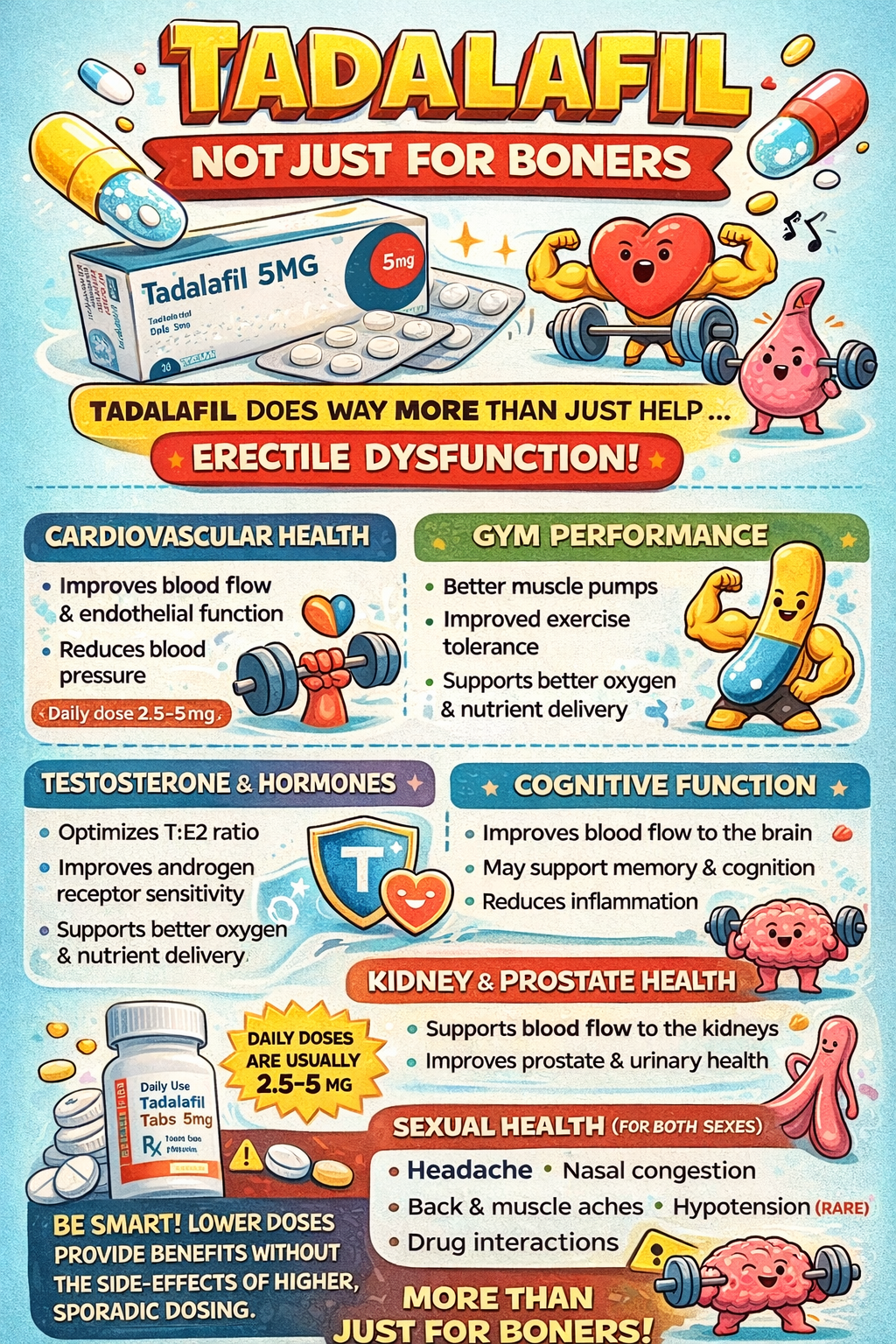
Low-dose daily tadalafil (2.5–5 mg) has been associated with:
Improved endothelial function
Reduced arterial stiffness
Lower blood pressure in hypertensive individuals
Reduced risk of major adverse cardiovascular events in men with ED (a proxy marker for vascular disease)
This matters because erectile dysfunction is often an early warning sign of cardiovascular disease, not a standalone problem. Treating vascular dysfunction early tends to improve everything downstream.
Observational data has even linked PDE5 inhibitor use with lower all-cause mortality, particularly in men with cardiometabolic disease. That’s not magic—that’s blood vessels doing their job better.
Women benefit here too. Endothelial dysfunction doesn’t care about sex chromosomes.
Gym Performance: Pumps Are Just the Tip of the Barbell
Yes, tadalafil can improve “the pump.” That’s the Instagram-friendly part.
The less flashy part:
Improved muscle perfusion
Better oxygen and nutrient delivery
Potential improvements in exercise tolerance
Lower afterload on the heart during exertion
Some data suggests PDE5 inhibition may enhance resistance training performance under certain conditions—not because it builds muscle directly, but because it reduces vascular friction.
This is not anabolic.
This is supportive physiology.
And no, it doesn’t replace protein, training, sleep, or electrolytes. It just makes the plumbing work better.
Testosterone, Androgens, and the Misunderstood Hormone Angle
Tadalafil does not directly raise testosterone.
But it can influence the system indirectly:
Improved blood flow to Leydig cells
Reduced systemic inflammation
Improved insulin sensitivity in some populations
Possible improvements in androgen receptor signaling
Some studies show modest improvements in free testosterone or T:E2 ratios, likely secondary to improved metabolic and vascular health—not because tadalafil is secretly a steroid.
Translation: better terrain, not more fuel.
Cognitive Function & Brain Blood Flow
The brain is an energy hog with zero tolerance for poor circulation.
PDE5 inhibitors cross the blood-brain barrier to a limited extent and may:
Improve cerebral blood flow
Reduce neurovascular inflammation
Support endothelial health in cerebral arteries
Emerging research has explored PDE5 inhibition in contexts like vascular dementia and cognitive decline. We’re early here, but the signal is intriguing.
Your brain, like your biceps, prefers oxygen-rich blood delivered on time.
Kidney & Prostate Health (Men Get This One, Women Still Benefit Systemically)
Tadalafil is FDA-approved for benign prostatic hyperplasia (BPH) because:
Kidney-wise, improved renal perfusion and reduced intraglomerular pressure may offer protective effects, particularly in hypertensive or metabolically compromised individuals.
Again: plumbing.
Sexual Health (Yes, Fine, Let’s Talk About It)
For men:
Improved erectile quality
Reduced performance anxiety (via reliability)
Improved orgasmic satisfaction in some studies
For women:
Increased genital blood flow
Improved arousal response
Potential improvements in orgasm quality
Possible benefit in certain pelvic pain disorders
Female sexual function is vascular too. The clitoris is not a decorative button. It’s erectile tissue.
Dosing: Less Is More (And Daily Beats Sporadic)
Most of the systemic benefits come from low-dose daily use:
This is not a “pre-workout Cialis blast.” That’s how you get headaches and regret.
Side Effects & Reality Checks
Most common:
Rare but important:
Hypotension (especially if combined with nitrates)
Visual disturbances (rare)
Drug interactions (alpha blockers, certain BP meds)
This is a prescription medication, not a supplement. Respect the tool.
The Big Picture
Tadalafil is not a libido drug.
It’s not a muscle builder.
It’s not a magic longevity pill.
It’s a vascular optimization compound that happens to have very noticeable effects in one very vascular organ.
If erections are the smoke, endothelial health is the fire.
And better blood flow is one of the most boring, powerful upgrades you can give a human system.
Blood flow isn’t sexy—until it is.
References
Andersson, K. E. (2018). PDE5 inhibitors—pharmacology and clinical applications 20 years after sildenafil discovery. British Journal of Pharmacology, 175(13), 2554–2565. https://doi.org/10.1111/bph.14205
Kloner, R. A., & Zusman, R. M. (2011). Cardiovascular effects of tadalafil. American Journal of Cardiology, 107(9), 1405–1410. https://pubmed.ncbi.nlm.nih.gov/14609622/
Hackett, G. (2019). Type 5 phosphodiesterase inhibitors in the management of erectile dysfunction: An update. Therapeutic Advances in Urology, 11, 1–14. https://pmc.ncbi.nlm.nih.gov/articles/PMC3776492/
Buvat, J., et al. (2013). Endothelial dysfunction and erectile dysfunction. Nature Reviews Urology, 10(3), 154–163. https://pmc.ncbi.nlm.nih.gov/articles/PMC3155232/
Montorsi, F., et al. (2004). Erectile dysfunction and coronary artery disease: A vascular connection. European Urology, 45(4), 461–466. https://pubmed.ncbi.nlm.nih.gov/16422857/