By Luis Villasenor, BS in Nutrition, Co-founder of Ketogains & DrinkLMNT
There’s a hard truth in the longevity space that doesn’t sell well:
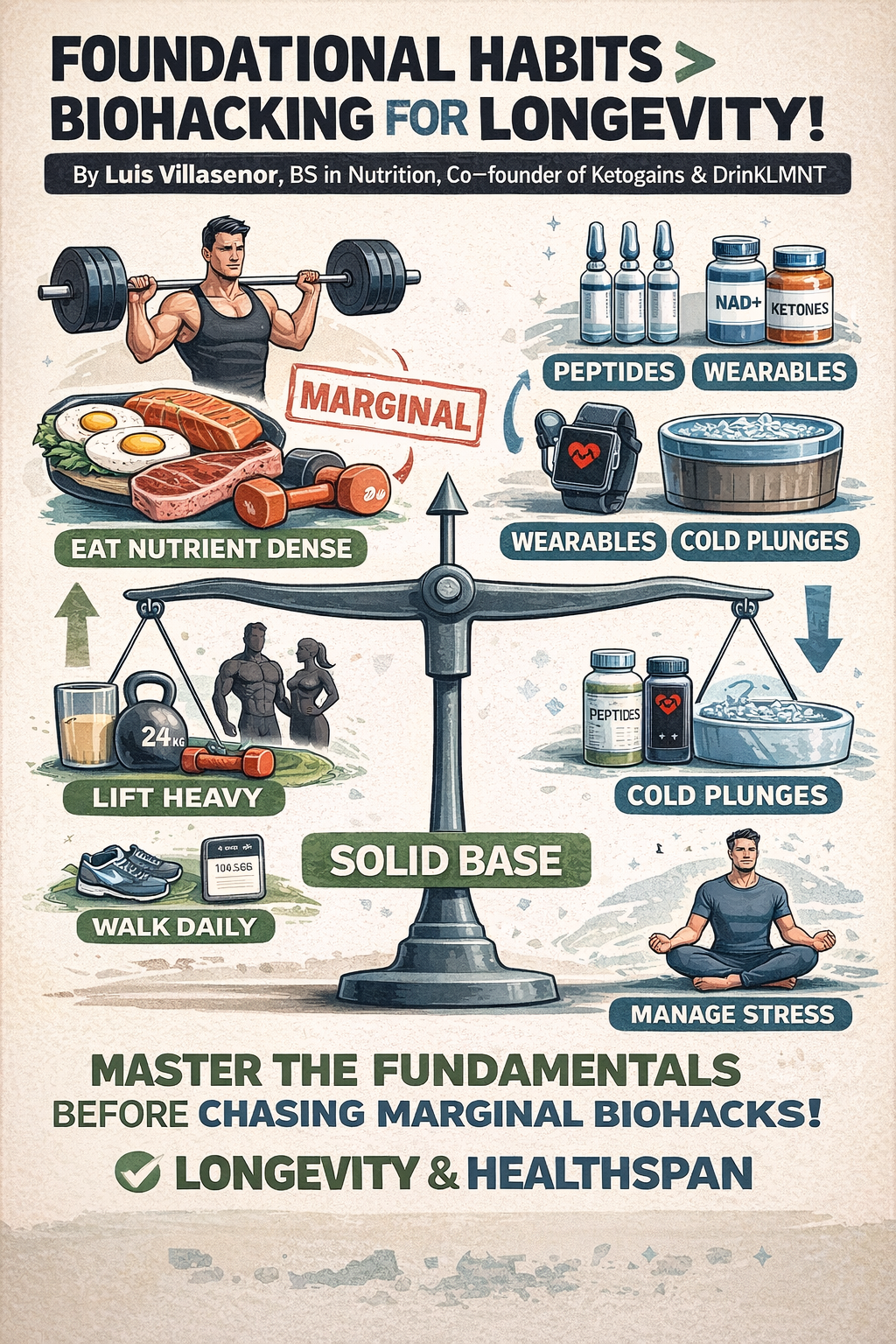
If you are lean, strong, metabolically healthy, sleep well, manage stress, and maintain meaningful relationships — you’ve already captured the vast majority of what currently extends human lifespan.
Everything else? Marginal gains.
And marginal gains only matter once the foundation is solid.
Let’s unpack this carefully — with science, not hype.
The Real Drivers of Lifespan (According to Data, Not Podcasts)
When we look at large epidemiological datasets — not influencer anecdotes — longevity consistently correlates with a few boring, repeatable variables:
1. Healthy Body Composition
Being overweight, especially with excess visceral fat, increases risk of:
Cardiovascular disease
Type 2 diabetes
Certain cancers
All-cause mortality
Even modest fat loss in overweight individuals improves risk markers substantially.
Reference:
Global BMI Mortality Collaboration. (2016). Body-mass index and all-cause mortality. The Lancet.
https://doi.org/10.1016/S0140-6736(16)30175-1
But here’s nuance:
Being lean is not the same as being under-muscled. Sarcopenic individuals (low muscle mass) with normal BMI have worse outcomes.
2. Strength and Muscle Mass
Muscle is not cosmetic tissue. It’s metabolic armor.
Higher grip strength, leg strength, and lean mass correlate strongly with lower mortality.
Reference:
Celis-Morales et al. (2018). Associations of grip strength with cardiovascular, respiratory, and cancer outcomes. BMJ.
https://doi.org/10.1136/bmj.k1651
Resistance training reduces mortality risk independent of cardio.
Reference:
Saeidifard et al. (2019). Resistance training and mortality risk. American Journal of Epidemiology.
https://doi.org/10.1093/aje/kwz124
Translation:
Lift weights. Eat adequate protein. Preserve muscle as you age.
At Ketogains we emphasize 1.6–2.2 g/kg protein daily — primarily from nutrient-dense animal sources — because muscle preservation is longevity insurance.
3. Cardiorespiratory Fitness
VO₂max (your ability to use oxygen during exercise) is one of the strongest predictors of survival.
Low fitness increases mortality risk more than smoking, hypertension, or diabetes in some cohorts.
Reference:
Blair et al. (1996). Physical fitness and all-cause mortality. JAMA.
https://doi.org/10.1001/jama.276.3.205
Zone 2 work plus strength training is not trendy. It’s foundational.
4. Social Connection & Purpose
Loneliness increases mortality risk similarly to smoking 15 cigarettes per day.
Reference:
Holt-Lunstad et al. (2010). Social relationships and mortality risk. PLOS Medicine.
https://doi.org/10.1371/journal.pmed.1000316
You cannot peptide your way out of isolation.
5. Stress & Sleep
Chronic stress elevates cortisol, worsens insulin resistance, increases visceral fat deposition, and disrupts immune function.
Poor sleep correlates with higher mortality, metabolic disease, and neurodegeneration.
These are not fringe findings. They are foundational physiology.
Now Let’s Talk About Biohacking
Peptides.
Continuous glucose monitors.
HRV tracking.
Cold plunges.
Red light therapy.
NAD boosters.
Exogenous ketones.
Are some of these interesting? Yes.
Are they useless? Not necessarily.
But here’s the uncomfortable hierarchy:
If you:
Don’t lift
Don’t eat enough protein
Overeat calories
Sleep 5 hours
Are chronically stressed
Have 30%+ body fat
Then your $800 peptide cycle is polishing a car with no engine.
Biohacking without behavioral discipline is technological cosplay.
Even wearables — useful tools — do not create discipline. They measure it.
Marginal Gains vs Foundational Gains
Think in terms of order of magnitude:
InterventionLifespan Impact (Estimated)Stop smokingMassiveMaintain healthy body fatLargeBuild & preserve muscleLargeImprove VO₂maxLargeSleep 7–9 hoursLargeMaintain strong relationshipsLargePeptides / NAD+ / longevity stacksUnknown / Small (if any)
Most “life extension” supplements lack long-term human mortality data. Mechanistic plausibility is not outcome data.
AMPK activation in a rodent does not equal human lifespan extension.
That’s not cynicism. That’s scientific humility.
The Peptide Conversation (Reality Check)
Even promising compounds like:
May help specific conditions.
But none override the mortality impact of obesity, inactivity, or muscle loss.
Pharmacology can assist physiology — it cannot replace it.
What Actually Moves the Needle
If you want practical longevity strategy, start here:
1. Body Fat in a Healthy Range
Men: ~10–18%
Women: ~18–25%
Avoid extremes.
2. Lift Heavy 3–5x Per Week
Progressively overload. Preserve muscle.
3. Eat Protein First
1.6–2.2 g/kg daily from whole food sources.
Beef, eggs, seafood. Nutrient density matters.
4. Walk Daily
8–10k steps baseline.
5. Sleep Like It’s Your Job
6. Maintain Real Relationships
7. Manage Stress Proactively
Do these consistently for 10+ years and you will outperform 95% of the biohacking crowd.
The Psychological Trap
Biohacking feels productive.
Fixing sleep hygiene, alcohol intake, and emotional regulation feels boring.
The market sells novelty. Biology rewards consistency.
A Forward-Thinking Perspective
The longevity field is young.
Future pharmacology may meaningfully extend lifespan.
But as of today?
No supplement stack has outperformed:
Healthy body composition
Strength
Aerobic fitness
Social connection
Purpose
Low chronic stress
You don’t need a lab coat to win longevity.
You need discipline applied patiently.
Final Take
If your base is weak, optimize your base.
If your base is strong, then — and only then — consider marginal tools.
Longevity is not about chasing the cutting edge.
It’s about mastering the fundamentals so thoroughly that the edge becomes optional.
And that truth will probably remain unpopular.
References
Blair, S. N., et al. (1996). Physical fitness and all-cause mortality. JAMA, 276(3), 205–210. https://doi.org/10.1001/jama.276.3.205
Celis-Morales, C. A., et al. (2018). Associations of grip strength with cardiovascular, respiratory, and cancer outcomes. BMJ, 361, k1651. https://doi.org/10.1136/bmj.k1651
Global BMI Mortality Collaboration. (2016). Body-mass index and all-cause mortality. The Lancet, 388(10046), 776–786. https://doi.org/10.1016/S0140-6736(16)30175-1
Holt-Lunstad, J., et al. (2010). Social relationships and mortality risk. PLOS Medicine, 7(7), e1000316. https://doi.org/10.1371/journal.pmed.1000316
Saeidifard, F., et al. (2019). Resistance training and mortality risk. American Journal of Epidemiology, 188(9), 1645–1652. https://doi.org/10.1093/aje/kwz124