There’s a recurring blind spot in the health and fitness world.
People debate macros, supplements, cold exposure, fasting windows, glucose monitors, and longevity stacks. Yet the variable that consistently predicts long-term success is rarely discussed in practical terms.
That variable is agency.
Not motivation.
Not genetics.
Not willpower in isolation.
Agency.
And without it, even the most evidence-based protocol fails in the real world.
What Agency Actually Means
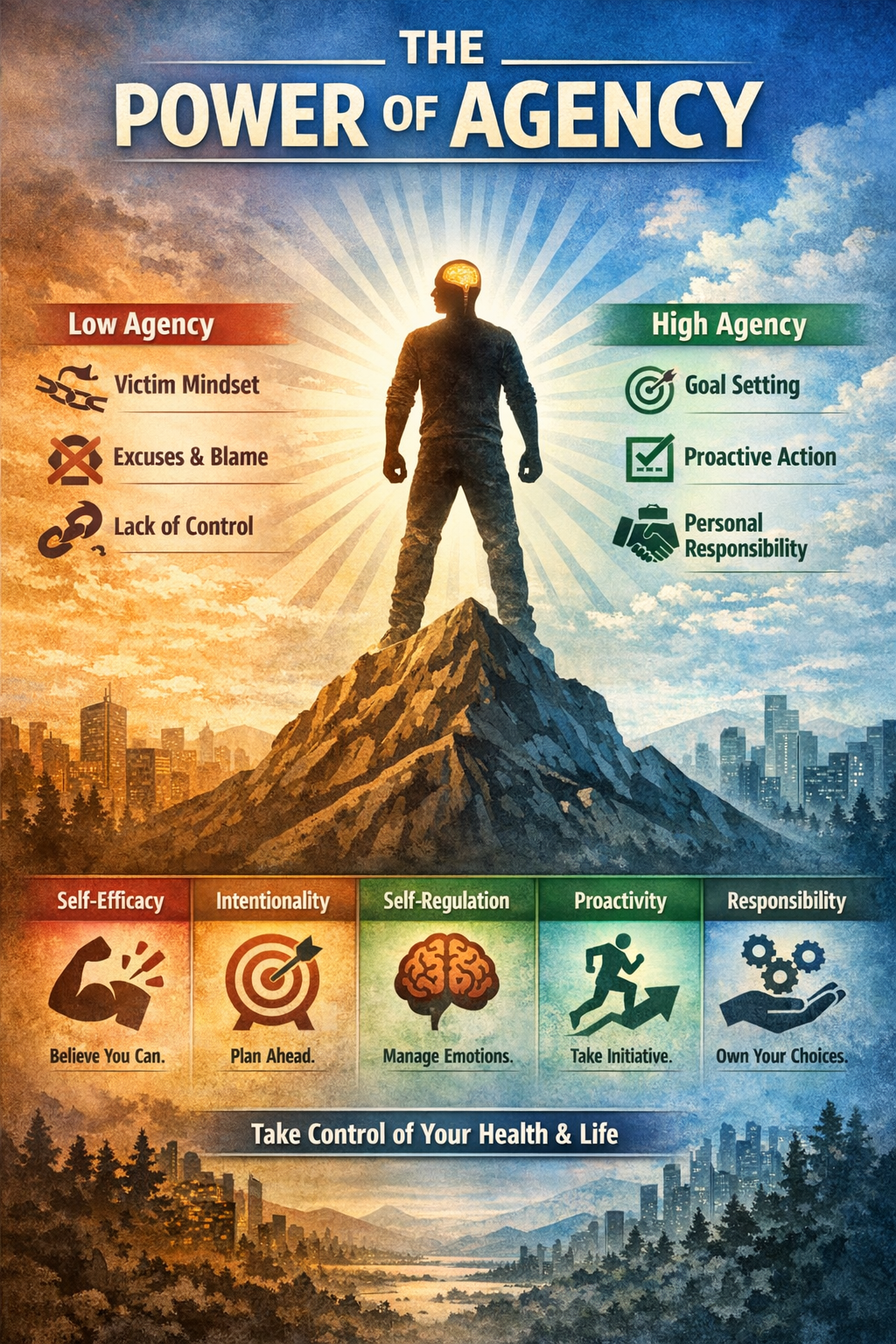
Agency is the capacity to:
Psychologically, agency overlaps with:
Self-efficacy — belief in one’s ability to execute behaviors required for desired outcomes (Bandura, 1977).
Internal locus of control — belief that outcomes are shaped by one’s actions rather than fate (Rotter, 1966).
Executive function — cognitive processes that enable planning, inhibition, and self-regulation (Diamond, 2013).
Agency is the behavioral integration of these constructs.
The Core Components of Agency
1. Self-Efficacy
Albert Bandura’s work demonstrated that self-efficacy strongly predicts whether individuals initiate and sustain behavior change (Bandura, 1997).
In health behavior specifically:
Higher exercise self-efficacy predicts better physical activity adherence (McAuley et al., 2011).
Self-efficacy is associated with improved dietary compliance and weight-loss outcomes (Teixeira et al., 2015).
Without belief in capability, effort collapses under friction.
2. Intentionality and Forethought
Agency requires goal-directed planning.
Implementation intention research shows that specifying when and how a behavior will occur dramatically increases adherence (Gollwitzer, 1999).
“I’ll eat better” is vague.
“I will eat 180g protein daily and train Monday, Wednesday, Friday at 7am” is executable.
Structured planning recruits prefrontal cortical systems responsible for executive control (Miller & Cohen, 2001).
Longevity behaviors are prefrontal behaviors.
3. Self-Regulation
Self-regulation predicts health, wealth, and even criminal outcomes decades later (Moffitt et al., 2011).
In dietary contexts:
Poor self-regulation correlates with higher BMI and impulsive eating (Vainik et al., 2019).
Emotion regulation ability predicts dietary adherence (Sainsbury et al., 2018).
Knowledge without regulatory capacity is inert.
4. Proactivity
Proactive personality traits are associated with improved goal attainment and adaptive health behaviors (Bateman & Crant, 1993).
High-agency individuals:
Behavioral economics shows that small environmental changes dramatically shift outcomes (Thaler & Sunstein, 2008).
Agency often expresses itself as environmental design.
5. Responsibility
Ownership correlates with an internal locus of control, which predicts better psychological and physical health outcomes (Ng, Sorensen, & Eby, 2006).
Responsibility does not mean self-blame.
It means recognizing behavioral causality.
This shift alone changes adherence patterns.
Internal vs. External Constraints
Agency exists within context.
Internal Variables
Mindset
Identity
Confidence
Emotional resilience
Identity-based behavior research suggests that actions consistent with one’s self-concept are more sustainable (Oyserman et al., 2007).
External Variables
Social determinants of health significantly influence behavioral outcomes (Marmot, 2005).
Acknowledging constraints is realistic.
Abdicating all influence is disempowering.
Agency is about leverage within constraint.
Low vs. High Agency in Dieting
Low Agency Pattern
Learned helplessness research shows that perceived lack of control reduces effort even when change is possible (Seligman, 1975).
High Agency Pattern
This mirrors principles of behavioral self-regulation theory (Carver & Scheier, 1982): behavior adjusts through feedback loops.
Agency and Longevity
Longevity research consistently highlights the same pillars:
Resistance training to preserve muscle mass (Westcott, 2012).
Adequate protein intake for muscle retention (Morton et al., 2018).
Cardiorespiratory fitness as a mortality predictor (Blair et al., 1996).
Sleep duration and quality for metabolic and cognitive health (Walker, 2017; Itani et al., 2017).
None of these are exotic.
All require repeated voluntary behavior.
Agency is the substrate.
The Neurobiology of Agency
Executive control networks in the prefrontal cortex regulate goal-directed behavior and inhibition (Miller & Cohen, 2001).
Sleep deprivation impairs these networks (Killgore, 2010).
Chronic stress reduces prefrontal regulation and increases impulsivity (Arnsten, 2009).
Which creates a loop:
Poor sleep and stress → reduced executive control → reduced agency → worse health behaviors.
Improving foundational health behaviors strengthens cognitive control systems.
Agency and health are reciprocal.
Agency Is Trainable
Agency is not a personality trait fixed at birth.
It scales through:
Small behavioral wins
Feedback tracking
Skill acquisition
Environmental design
Behavioral mastery increases self-efficacy (Bandura, 1997).
Self-efficacy increases persistence.
Persistence increases outcomes.
Agency compounds.
Final Perspective
The most powerful “protocol” in diet, longevity, and self-improvement is not a macronutrient ratio or supplement stack.
It is the sustained belief—validated through repeated evidence—that your actions produce meaningful outcomes.
Agency converts:
Health is an accumulation of voluntary behaviors across decades.
Agency is the engine that sustains them.
References
Arnsten, A. F. T. (2009). Stress signalling pathways that impair prefrontal cortex structure and function. Nature Reviews Neuroscience, 10(6), 410–422. https://doi.org/10.1038/nrn2648
Bandura, A. (1977). Self-efficacy: Toward a unifying theory of behavioral change. Psychological Review, 84(2), 191–215.
Bandura, A. (1997). Self-efficacy: The exercise of control. Freeman.
Bateman, T. S., & Crant, J. M. (1993). The proactive component of organizational behavior. Journal of Organizational Behavior, 14(2), 103–118.
Blair, S. N., et al. (1996). Influences of cardiorespiratory fitness and other precursors on cardiovascular disease and all-cause mortality. JAMA, 276(3), 205–210.
Carver, C. S., & Scheier, M. F. (1982). Control theory: A useful conceptual framework for personality–social psychology. Psychological Bulletin, 92(1), 111–135.
Diamond, A. (2013). Executive functions. Annual Review of Psychology, 64, 135–168.
Gollwitzer, P. M. (1999). Implementation intentions. American Psychologist, 54(7), 493–503.
Itani, O., et al. (2017). Short sleep duration and health outcomes: A systematic review. Sleep Medicine, 32, 246–256.
Killgore, W. D. S. (2010). Effects of sleep deprivation on cognition. Progress in Brain Research, 185, 105–129.
Marmot, M. (2005). Social determinants of health inequalities. The Lancet, 365(9464), 1099–1104.
McAuley, E., et al. (2011). Self-efficacy and health behavior change. American Journal of Lifestyle Medicine, 5(2), 99–110.
Miller, E. K., & Cohen, J. D. (2001). An integrative theory of prefrontal cortex function. Annual Review of Neuroscience, 24, 167–202.
Moffitt, T. E., et al. (2011). A gradient of childhood self-control predicts health, wealth, and public safety. PNAS, 108(7), 2693–2698.
Morton, R. W., et al. (2018). A systematic review of protein supplementation on muscle mass and strength. British Journal of Sports Medicine, 52(6), 376–384.
Ng, T. W. H., Sorensen, K. L., & Eby, L. T. (2006). Locus of control at work: A meta-analysis. Journal of Organizational Behavior, 27(8), 1057–1087.
Oyserman, D., et al. (2007). Identity-based motivation. Psychological Bulletin, 133(6), 1011–1027.
Sainsbury, K., et al. (2018). Emotion regulation and weight loss. Obesity Reviews, 19(3), 367–378.
Seligman, M. E. P. (1975). Helplessness: On depression, development, and death. Freeman.
Teixeira, P. J., et al. (2015). Motivation, self-determination, and long-term weight control. International Journal of Behavioral Nutrition and Physical Activity, 12, 2.
Thaler, R. H., & Sunstein, C. R. (2008). Nudge. Yale University Press.
Vainik, U., et al. (2019). Neurobehavioral correlates of obesity and self-control. Neuroscience & Biobehavioral Reviews, 98, 102–116.
Walker, M. (2017). Why we sleep. Scribner.
Westcott, W. L. (2012). Resistance training is medicine. Current Sports Medicine Reports, 11(4), 209–216.*