By Luis Villaseñor, BS in Nutrition – Co-Founder of Ketogains & DrinkLMNT
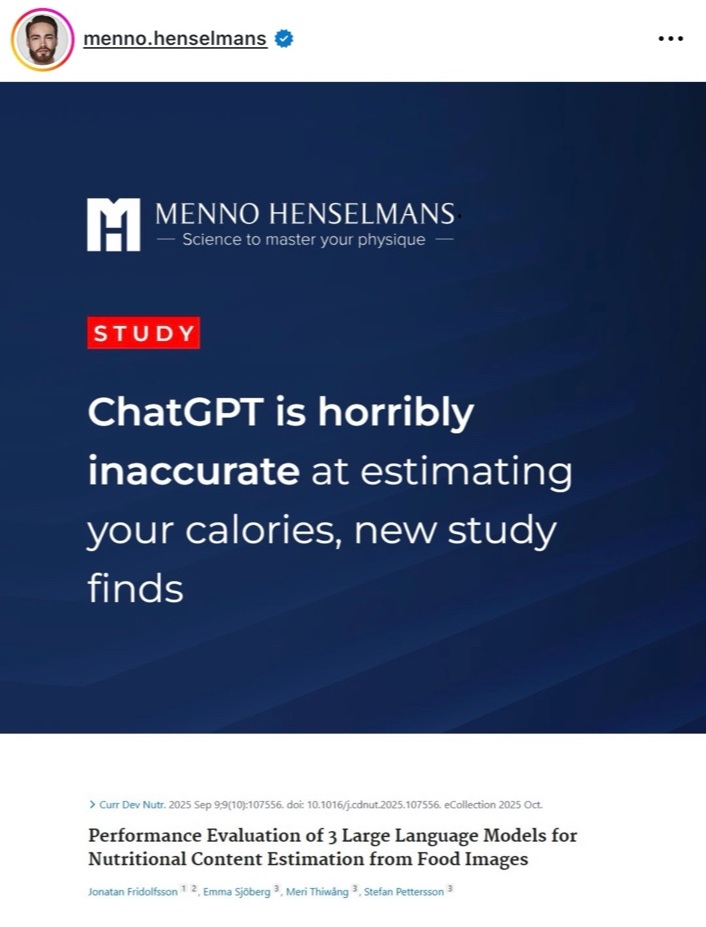
Artificial intelligence has made giant strides in recent years… but when it comes to estimating your calories from a simple food photo, the bots still trip over their digital shoelaces.
A new study—highlighted and correctly interpreted by Menno Henselmans—confirms what those of us who live in the trenches of nutrition coaching already suspected: AI is nowhere near accurate enough to track your macros for you.
And the findings aren’t “slightly off.”
They’re catastrophically inaccurate.
Let’s break it down.
AI + Food Pictures = 36% Error (On Average!)
The study looked at whether large language models (LLMs) like ChatGPT, Claude, and Gemini could accurately determine:
ingredients
portion size
calories
macronutrients
…using just a photograph of the meal.
The verdict?
They can’t.
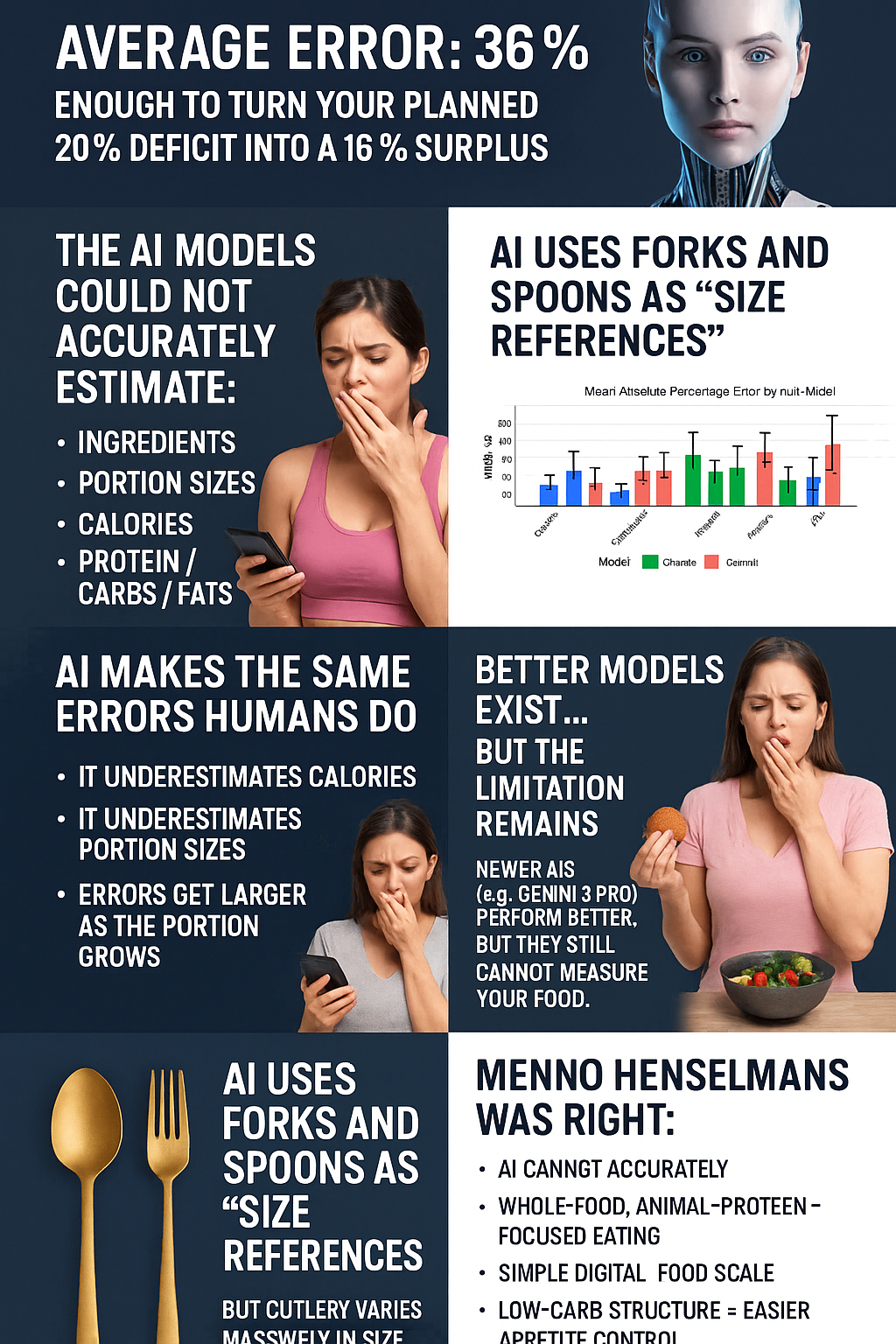
The best model had an average error rate of 36%.
To put that in real-life terms:
If you're planning a 20% caloric deficit for fat loss, AI’s mistakes could turn it into a 16% caloric surplus. That means weight gain while trying to cut—a nightmare scenario for anyone pursuing body recomposition.
Why Are The Errors So Huge?
The researchers found multiple systematic problems:
1. AI underreports calories just like humans.
And as Menno pointed out, that’s the same bias we see in self-reported diet studies (which is why we at Ketogains don’t rely on subjective reporting).
The problem gets worse with larger portion sizes— exactly the portions fitness people tend to eat.
2. AI uses cutlery to estimate size.
Forks, spoons, knives.
The models guess portion size based on what’s in the picture.
This sounds clever… until you realize:
cutlery sizes vary wildly
angles distort perspective
plating differences deceive the model
If the photos didn’t include utensils, the accuracy tanked even further.
3. Even “newer” models still operate with the same limitations.
This study used earlier versions (ChatGPT-4o, Claude 3.5 Sonnet, Gemini 1.5 Pro).
Better models now exist—Gemini 3 Pro being the standout—but the fundamental problem remains:
AI can’t measure food from a picture.
It can guess, and guesses ≠ calories.
Menno’s Interpretation: Spot On
Menno Henselmans has built a career analyzing data with brutal precision.
His takeaways match both the science and what coaches see every day:
AI is not reliable for calorie counting
AI cannot accurately estimate body fat % from images (yet)
Self-estimation—if you’re experienced—is still more reliable
Eating ad libitum (intuitively) can work well if your food environment is structured
We might get accurate AI tracking eventually, but the tech is nowhere close today
He’s right.
And this is important because many people desperately want shortcuts.
Unfortunately, no AI tool can replace the fundamentals: weighing food, repeating meals for consistency, and learning what proper portions look like.
Why This Matters for Body Recomposition
If you’re trying to lose fat, gain muscle, or maintain leanness, accuracy matters.
Imagine eating this:
250 g ribeye
200 g potatoes
100 g veggies
Now imagine AI estimating it as:
180 g ribeye
120 g potatoes
50 g veggies
That’s a massive difference in protein, fat, carbs, and total calories.
For recomposition—where we walk the tightrope of maintaining muscle while dropping fat—precision is your ally. AI’s guesswork isn’t.
What Actually Works?
1. Repeatable meals
Not boring—just structured.
Consistency makes tracking easy.
2. Whole, animal-protein–centric low-carb nutrition
The backbone of the Ketogains protocol:
Much harder to mis-estimate a steak than a bowl of pasta.
3. Simple digital scales
The cheapest, most reliable “AI” in your home.
4. Experienced self-estimation over time
You get better at eyeballing portions the more you practice.
5. Stop outsourcing responsibility
Use tools to support your diet, not run it for you.
The Future of AI Nutrition Tracking
Will AI eventually get good enough?
Probably.
Computer vision will improve, measurement algorithms will get smarter, and data sets will expand.
But as of 2025, the dream of snapping a picture and perfectly tracking your macros simply isn’t real.
Until then, Menno’s advice—and mine—still stands:
You’re better off learning the process instead of trying to automate it.
Because mastery beats convenience every time.
References
Fridolfsson, J., Sjöberg, E., Thiwang, M., & Pettersson, S. (2025). Performance evaluation of 3 large language models for nutritional content estimation from food images. Current Developments in Nutrition, 9(10), 107556. https://doi.org/10.1016/j.cdnut.2025.107556
Henselmans, M. (2025). Analysis of AI macro-tracking accuracy. Instagram post series.
Schoeller, D. A. (2018). How accurate is self-reported dietary energy intake? Nutrients, 10(1), 90. https://doi.org/10.3390/nu10010090