By Luis Villaseñor, BS in Nutrition, Co-founder of Ketogains & DrinkLMNT
The Supplement Maze
In the ever-expanding world of health and fitness, supplements promise everything from faster fat loss to superhuman recovery. But here’s the truth: most supplements are either misused, underdosed, or simply unnecessary.
A well-constructed diet, adequate sleep, and consistent training cover 90% of what you need. Supplements—by definition—supplement what’s missing. They’re the icing, not the cake.
Yet, with thousands of products claiming to “boost metabolism,” “detox your liver,” or “build lean muscle,” the question becomes:
How do you tell what’s worth your money—and what’s marketing hype?
This guide breaks down a scientific and practical decision framework—the Ketogains way—to help you evaluate any supplement like a pro.
1. What Does This Supplement Do?
Understand the Claim
Start by identifying what the product claims to do. Does it:
Increase energy or performance?
Improve recovery or muscle gain?
Support sleep, mood, or cognition?
Correct a nutrient deficiency?
Once you identify the claim, look for the evidence.
Ask:
Are there peer-reviewed studies supporting this effect?
Were these studies conducted in humans, not just animals or cell cultures?
Were they independent, or funded by the company selling the product?
If studies are industry-funded or only show effects in rodents or in vitro, the results should be taken with a grain of salt.
⚠️ Red flag: “Incredible” claims that sound too good to be true (e.g., “Lose 10 lbs in 7 days!” or “Reverse aging overnight”) almost always are.
2. Why Should I Take It?
Is It Addressing a Real Need?
A supplement is worthwhile only if it supports a specific goal or addresses a real deficiency.
Ask yourself:
Am I lacking this nutrient in my diet? (e.g., magnesium, vitamin D, omega-3s)
Is there a legitimate performance or health reason to use it? (e.g., creatine for muscle and brain health, protein for muscle repair)
Can I get the same benefit from whole foods or lifestyle improvements?
If the answer is “yes,” fix your diet and sleep first before resorting to supplements.
“You can’t supplement your way out of a poor diet or lifestyle.” — Ketogains Principle
Examples
Magnesium: justified if you’re on a low-carb diet, sweat heavily, or have symptoms like cramps or poor sleep.
Creatine monohydrate: scientifically proven for performance, cognition, and muscle retention—useful for almost everyone.
Fat burners, detox teas, or proprietary blends: typically marketing-driven, with minimal or no real evidence.
3. How Should I Take It?
Timing and absorption matter. Even the best supplement won’t help if taken incorrectly.
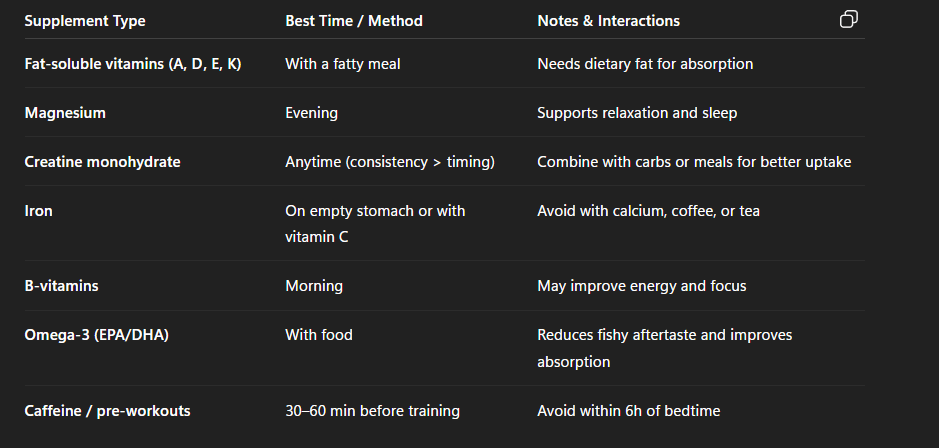
Always check for interactions:
Calcium competes with iron and zinc absorption.
High doses of zinc can lower copper levels.
Vitamin D increases calcium uptake; take with magnesium to maintain balance.
4. How Much? Understanding Dosage and Label Confusion
Most people go by “2 capsules per day” instead of looking at the actual clinical dose.
This is where most supplements fail.
A supplement should provide the effective dose proven in research—not just a sprinkle for marketing appeal.
Example:
Creatine Monohydrate: Clinical dose = 3–5 g/day
If your supplement label says “1,000 mg per serving,” that’s 1 g, not enough.
Magnesium: Effective dose = 200–400 mg elemental magnesium/day, depending on diet and form (glycinate > oxide).
Fish oil (EPA/DHA): Minimum 1–2 g combined EPA + DHA/day for cardiovascular and anti-inflammatory benefits.
Always check the Supplement Facts panel for:
The exact amount per serving
The form of the ingredient (bioavailability matters)
Whether doses are in mg, mcg, IU, or grams
5. Beware of Proprietary Blends
If a product lists “Proprietary Formula – 2,000 mg” with no specific breakdown of each ingredient, that’s a major red flag.
These blends hide how much of each ingredient is actually present—often underdosing expensive actives while padding with cheap fillers.
Rule of thumb:
If you don’t know exactly how much of each compound is inside, don’t buy it.
6. Avoid “Kitchen Sink” Formulas
Many “all-in-one” products promise total health in one scoop—vitamins, minerals, nootropics, adaptogens, and fat burners all crammed together.
The truth? Less is more.
A good supplement typically focuses on no more than 3–4 active ingredients with clear synergy and clinical backing.
Examples of good formulation philosophy:
Electrolyte mix (like LMNT): sodium + potassium + magnesium, no fillers or sugar.
Joint formula: collagen + vitamin C + MSM.
Sleep formula: magnesium + glycine + theanine.
If it reads like a grocery list, it’s usually underdosed marketing fluff.
7. Other Practical Tips
✅ Choose the Right Form
The form of a supplement affects absorption and effectiveness:
Magnesium glycinate > oxide (better absorbed, less GI distress)
Zinc picolinate > gluconate or oxide
Creatine monohydrate = gold standard (cheap, stable, effective)
✅ Check for Third-Party Testing
Look for certifications like:
NSF Certified for Sport
Informed Choice
USP Verified
These confirm purity and label accuracy—especially important for athletes.
✅ Understand the Law of Diminishing Returns
Once your diet, sleep, and training are optimized, most supplements yield small incremental benefits.
The “magic bullet” doesn’t exist.
✅ Don’t Stack Randomly
More isn’t better. Stacking too many stimulants, adaptogens, or minerals can cause adverse interactions or nutrient imbalances.
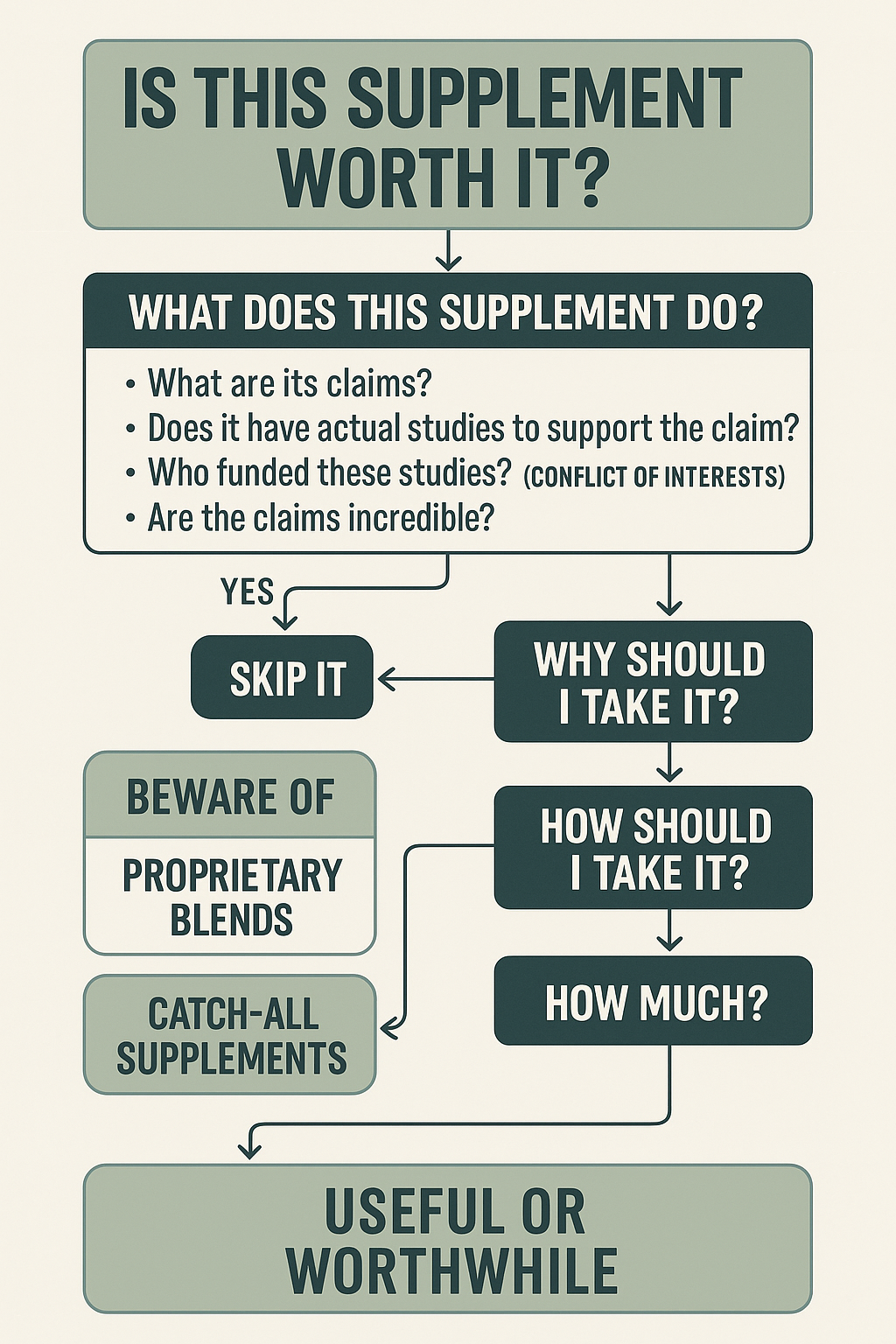
8. How to Decide if a Supplement Is Worth It
Use this 5-step decision path before buying:
Identify the claim → What does it promise?
Check the evidence → Are there independent human studies?
Compare the dose → Is it clinically relevant?
Evaluate necessity → Do you actually need it?
Confirm transparency → Does it list full amounts and forms?
If it fails any of the above, skip it.
Invest in food, training, and recovery first.
Conclusion: Supplement Smart, Not Hard
Supplements can be powerful tools—but only when used strategically and intelligently.
The real foundation remains:
Whole, nutrient-dense foods
Adequate protein (≈1.2g per lean lb / 2.4g per kg)
Strength training
Electrolyte balance and hydration
Rest and sunlight
Once you have those pillars in place, supplements can enhance your results—not replace your habits.
References
Kerksick, C. M., et al. (2018). International society of sports nutrition position stand: nutrient timing. Journal of the International Society of Sports Nutrition, 15(1), 38. https://doi.org/10.1186/s12970-018-0242-y
Maughan, R. J., Burke, L. M., & Dvorak, J. (2018). IOC consensus statement: dietary supplements and the high-performance athlete. British Journal of Sports Medicine, 52(7), 439–455. https://doi.org/10.1136/bjsports-2018-099027
Examine.com. (2025). Supplement Guides and Human Effect Matrix. https://examine.com
Goston, J. L., & Correia, M. I. (2010). Intake of nutritional supplements among people exercising in gyms and influencing factors. Nutrition, 26(6), 604–611. https://doi.org/10.1016/j.nut.2009.06.021