By Luis Villaseñor, BS in Nutrition | Co-Founder of Ketogains & DrinkLMNT
A funny thing happens when you coach hundreds—eventually thousands—of people over the years. Patterns appear. Not in genetics, not in macros, not in training splits. In attitude.
Two people can follow the same program, eat the same protein-rich meals, lift the same weights, and have access to the same tools… yet end up with wildly different results. One gets leaner, stronger, more capable every month. The other gets stuck, frustrated, spinning in circles.
The difference is rarely calories or reps.
The difference is how they respond when things get hard.
That’s where success is won or lost.
Attitude isn’t fluff. It’s a force multiplier. It determines how you interpret setbacks, how quickly you reset, and whether you keep moving forward instead of collapsing at the first sign of resistance.
Let’s break down why.
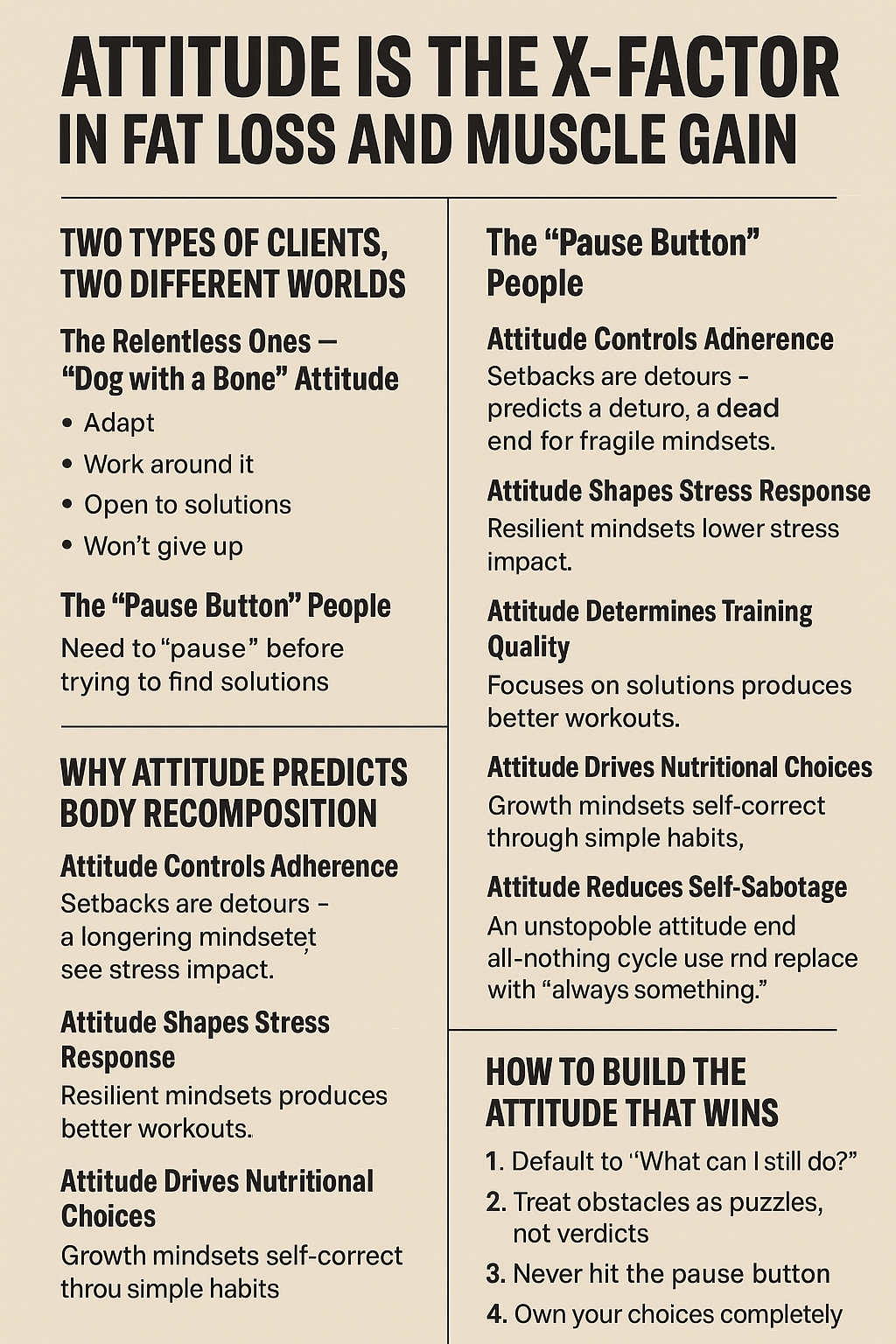
Two Types of Clients, Two Different Worlds
Across all the years of coaching, the biggest predictor of long-term success isn’t starting motivation, genetics, or even consistency. The biggest predictor is how someone behaves when life punches them in the face—because life eventually does.
I’ve coached two archetypes:
1. The Relentless Ones — “Dog with a Bone” Attitude
These people aren’t perfect. But when life throws a curveball—injury, stress, schedule changes, travel—they immediately ask:
“Okay, what can I do?”
They adapt. They keep protein high. They modify training. They hit steps. They stay hydrated. They accept responsibility. They get curious instead of defeated.
They don’t need the perfect plan.
They just need a plan—and they run with it.
This is the person who ends up leaner, stronger, more resilient year after year.
2. The “Pause Button” People
These folks see a setback and immediately freeze.
Travel? “Pause.”
Stressful week? “Pause.”
Kids sick? “Pause.”
Scale didn’t move? “Pause.”
Missed a workout? “Pause.”
Mercury in retrograde? “Pause.”
And they convince themselves that pausing is logical—when in reality, it’s surrender disguised as strategy.
They blame circumstances, schedules, coworkers, macros, the scale, anything except their own choices.
The story always sounds like:
“I’ll start again when things settle down.”
Here’s the truth:
Things never settle down. That mythical perfect window never arrives. Life stays messy.
And because they stop every time it gets messy, they never string together enough momentum to transform.
Why Attitude Predicts Body Recomposition
Fat loss and muscle gain thrive on consistency—not perfection. And consistency is directly shaped by mindset.
A few key mechanisms explain why:
1. Attitude Controls Adherence
Every program works if you follow it long enough.
Attitude determines whether you stay in the game.
A setback to a committed mindset is just a detour.
A setback to a fragile mindset is a dead end.
2. Attitude Shapes Stress Response
High stress increases cravings, disrupts sleep, and elevates cortisol—all of which can slow fat loss.
But how you perceive stress changes your physiological reaction to it.
People with resilient mindsets experience lower negative impact from stress.
Your brain is not a passive observer—it’s a filter that changes what your body does.
3. Attitude Determines Training Quality
Two athletes can run the same workout:
One focuses on solutions, pushes with intent, uses internal focus, adjusts loads, and stays engaged.
The other complains, half-asses reps, loses tension, and mentally checks out.
Guess whose workouts produce more hypertrophy?
(And yes, internal focus and intent matter—multiple studies demonstrate improved hypertrophy simply by focusing on the target muscle.)
4. Attitude Drives Nutritional Choices
A poor mindset defaults to emotional eating, all-or-nothing behavior, or “screw it” spirals.
A growth mindset self-corrects quickly:
High-protein meals.
Hydration.
Steps.
Electrolytes.
Simple habits executed consistently.
That’s where results compound.
5. Attitude Reduces Self-Sabotage
Most people don’t fail because the plan is bad.
They fail because they abandon it at the first hint of imperfection.
An unstoppable attitude ends the all-or-nothing cycle and replaces it with “always something.”
That’s the real secret.
The Science Behind Why Attitude Matters
This isn’t motivational poster nonsense. There’s real evidence showing:
• Self-efficacy (belief you can solve problems) predicts fat loss success more than diet choice.
• Growth mindset increases persistence and long-term behavior adherence.
• Cognitive reframing reduces stress-driven eating.
• Locus of control (internal responsibility vs external blame) predicts whether people stick to training long-term.
• Resilient attitudes lead to higher training quality and better recovery.
Your physiology follows your psychology.
How to Build the Attitude That Wins
A winning attitude isn’t something you’re born with. It’s a skill—built rep by rep.
Here’s the operating system:
1. Default to “What can I still do?”
If the perfect plan breaks, run the imperfect one.
2. Treat obstacles as puzzles, not verdicts.
You’re experimenting, not failing.
3. Never hit the pause button.
Just shift gears. Even in chaos, there’s always a minimum effective dose.
4. Own your choices completely.
Responsibility gives you power. Blame gives you excuses.
5. Break the chain quickly.
Bad day? Fine. Bad week? No. Reset on the very next choice.
6. Stay curious, not emotional.
Curiosity keeps you learning. Emotion keeps you stuck.
The Attitude That Builds a Strong, Lean, Capable Body
Fat loss and muscle gain aren’t just biological processes—they’re psychological transformations.
When you develop the mindset that refuses to quit, refuses to blame, and refuses to pause, your body composition finally reflects the effort you’ve always wanted to see.
Progress is not about perfection.
Progress is about relentless forward motion—even when the world is messy.
Attitude isn’t part of the program.
Attitude is the program.