By Luis Villaseñor, BS in Nutrition | Co-Founder of Ketogains & DrinkLMNT
The fantasy of getting shredded in a month is as persistent as it is misleading. The body doesn’t work on wishful thinking — it works on physiology, energy balance, and the delicate dance between fat loss and muscle retention.
Losing fat too fast is one of the most reliable ways to sabotage long-term progress: hunger spikes, training performance tanks, NEAT drops, hormones take a hit, and muscle loss becomes very real.
Losing fat too slow can feel like spinning your wheels.
There is a sweet spot — and it depends heavily on your current body-fat percentage.
Below is a science-grounded, Ketogains-aligned breakdown of weekly fat-loss rates, why they matter, and real-world examples so you can apply them immediately.
Why Fat-Loss Rate Matters More Than Most People Realize
The leaner you are, the more protective your body becomes over stored energy.
Think of body fat like a savings account. If you’re “wealthy” (higher body fat), withdrawing aggressively is tolerated. If you’re “broke” (very lean), every withdrawal gets scrutinized.
Your body will defend muscle tissue if you give it enough fuel, protein, training stimulus, and recovery — but push the deficit too hard and muscle becomes collateral damage.
That’s why recommended fat-loss rates scale down as you get leaner.
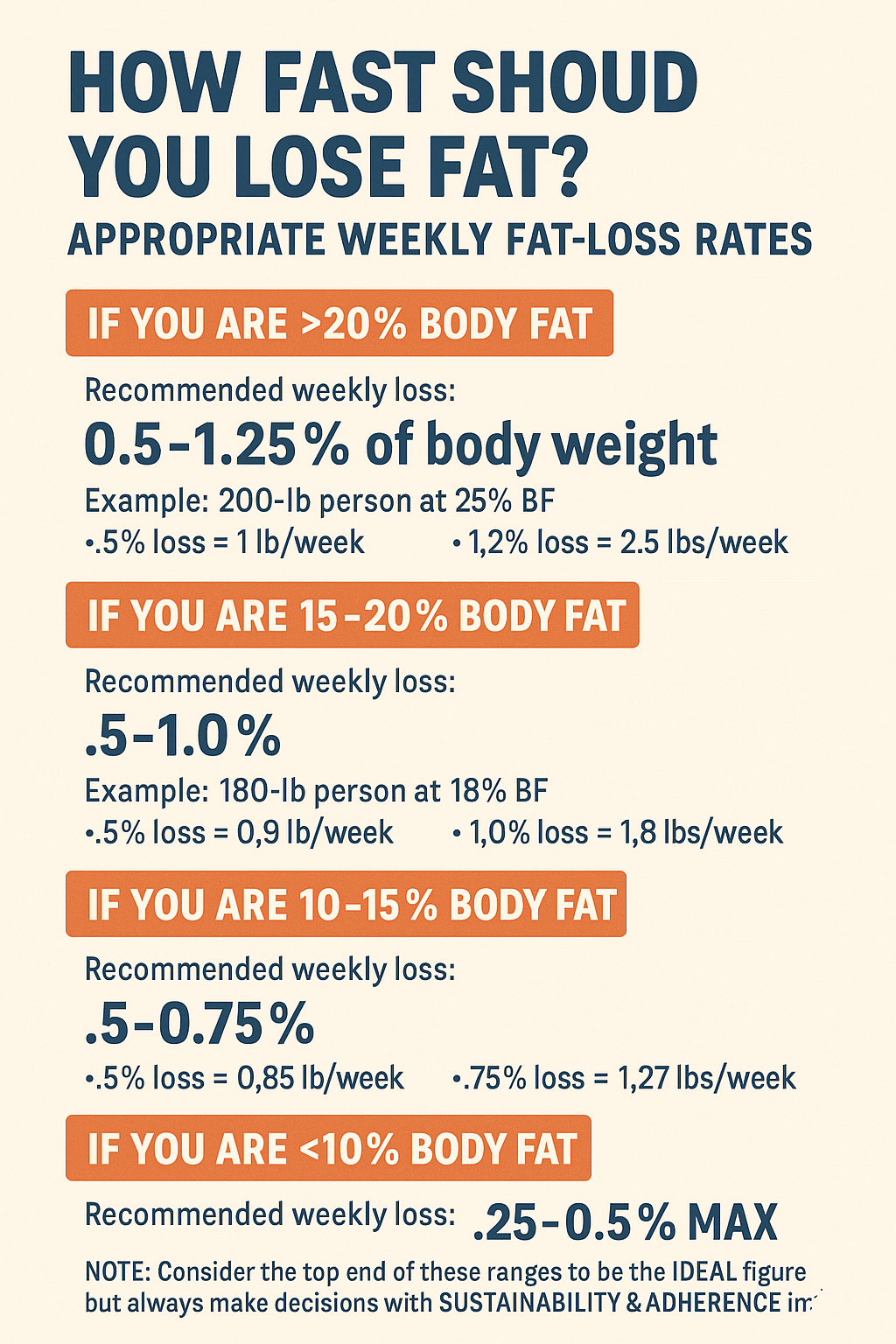
Recommended Weekly Fat-Loss Rates
(Numbers below assume men; women should use body-fat categories roughly 8–10% higher for comparable physiological stages.)
1. If You Are >20% Body Fat
Recommended weekly loss: 0.5–1.25% of total bodyweight
Upper limit: 1–1.25% if adherence is high and recovery is solid.
At this level, your body has plenty of stored energy. Muscle loss risk is low as long as you keep protein high (~1g/lb lean mass), train with intensity, and maintain electrolytes.
Example:
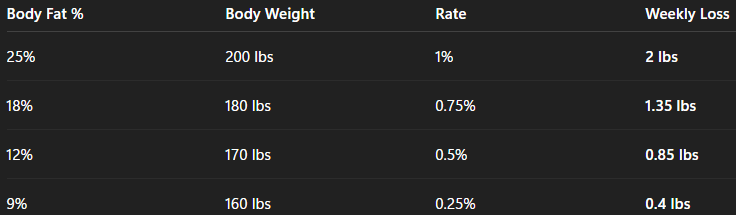
A 200-lb person at 25% BF
• 0.5% loss = 1.0 lb/week
• 1.25% loss = 2.5 lbs/week
Totally reasonable and sustainable for many.
Who this category fits:
People returning to training, people with higher body fat, individuals starting a recomposition phase with a big runway.
2. If You Are 15–20% Body Fat
Recommended weekly loss: 0.5–1.0%
Upper limit: ~1% under ideal conditions.
You can still push fat loss somewhat aggressively but need to monitor performance and hunger more closely. NEAT (non-exercise movement) tends to drop here if calories are very low.
Example:
A 180-lb person at ~18% BF
• 0.5% loss = 0.9 lb/week
• 1.0% loss = 1.8 lbs/week
Who this category fits:
Most people trying to look athletic, beach lean, or beginning a more serious cut.
3. If You Are 10–15% Body Fat
Recommended weekly loss: 0.5–0.75% of bodyweight
This is where cuts start feeling more delicate. Hunger increases. Training performance becomes more sensitive. Sleep quality can take a hit if the deficit is too aggressive.
Example:
A 170-lb person at 12% BF
• 0.5% loss = 0.85 lb/week
• 0.75% loss = 1.27 lbs/week
This is the “lean but not shredded” range — aesthetics start popping, but aggressive dieting risks muscle loss.
4. If You Are <10% Body Fat
Recommended weekly loss: 0.25–0.5% MAX
Going slower is often smarter.
This is competition territory or peak vanity cutting.
The body aggressively resists further fat loss at this stage: testosterone, thyroid hormones, leptin, and resting metabolic rate start dropping. Training performance can suffer if deficit is too deep.
Example:
A 160-lb person at 9% BF
• 0.25% loss = 0.4 lb/week
• 0.5% loss = 0.8 lb/week
Trying to lose 1–2 lbs/week here is a recipe for muscle loss, chronic fatigue, and hormonal disruption.
Who this category fits:
Bodybuilders, fitness models, photo-shoot prep, or anyone chasing abs-on-abs leanness.
A Simple Rule of Thumb
As you get leaner, your deficit should shrink.
Big deficit when fluffy.
Moderate deficit when athletic.
Small deficit when shredded.
Examples: Side-by-Side Comparison
Choosing Your Rate of Loss: Sustainability First
Regardless of category, the top end of the range is ideal only under perfect conditions:
• High protein intake (Ketogains guideline: 0.8–1g/lb LBM minimum)
• Strength training 3–5x/week
• Sufficient electrolytes (especially sodium — most cuts fail from low intake)
• Good sleep
• Low stress
• High dietary adherence
• Mostly whole-food, animal-protein-centric eating
If any of those pillars wobble, aim for the lower end of the fat-loss range.
The goal isn’t the fastest fat loss.
The goal is maximum fat loss with minimum muscle loss — and the ability to maintain your results without rebound.
Final Reflection
Fat loss is a controlled burn, not a wildfire.
Move too fast and you burn muscle, motivation, and metabolism.
Move too slow and frustration breaks adherence.
Pick your weekly target based on where you are right now — not where you wish you were — and adjust as needed.
Master the basics, respect physiology, and progress becomes inevitable.
References
Garthe, I., & Maughan, R. J. (2018). Athletes and weight management: Is rapid weight loss harmful? Sports Medicine, 48(1), 97–110. https://doi.org/10.1007/s40279-017-0797-9
Helms, E. R., Aragon, A. A., & Fitschen, P. J. (2014). Evidence-based recommendations for natural bodybuilding contest preparation. Journal of the International Society of Sports Nutrition, 11(1), 20. https://doi.org/10.1186/1550-2783-11-20
Mettler, S., Mitchell, N., & Tipton, K. D. (2010). Increased protein intake reduces lean body mass loss during weight loss in athletes. Medicine & Science in Sports & Exercise, 42(2), 326–337. https://doi.org/10.1249/MSS.0b013e3181b2ef8
Hall, K. D., et al. (2016). Ultra-processed diets cause excess calorie intake and weight gain: An inpatient randomized controlled trial of ad libitum food intake. Cell Metabolism, 30(1), 67–77. https://doi.org/10.1016/j.cmet.2019.05.008